
The Defense Rests in the Tupac Murder Trial — Closing Arguments Set for Monday

Nearly 30 years after Tupac Shakur was gunned down in Las Vegas, the trial of the only man ever charged in his death is hurtling toward a verdict. The defense rested its case Thursday afternoon, and closing arguments are scheduled to begin Monday morning. The jury could begin deliberations by the end of next week.
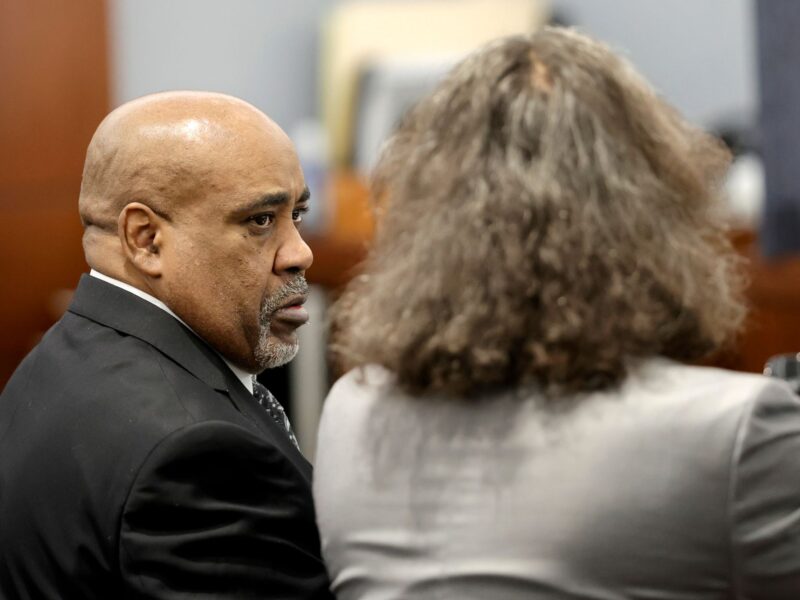
The case centers on Duane “Keffe D” Davis, 63, a former Compton gang member who prosecutors say was in the white Cadillac from which the fatal shots were fired on September 7, 1996. Davis has admitted in his own book, Compton Street Legend, and in multiple interviews with law enforcement and documentarians that he was in the vehicle that night. The defense, however, argues those statements were embellished, self-serving, and insufficient to prove Davis was actually in Las Vegas at the time of the shooting.
Key Testimony from the Defense

The defense called three former Las Vegas police officers to the stand Thursday, including homicide detective Dan Long, who spent years investigating Shakur’s murder. Long testified about a chance encounter with Deandre “Dre” Smith, another man witnesses said was in the Cadillac that night. In 2004, while on a tour of Compton, Long spotted Smith walking through a field. When Long tried to question him, Smith responded with an expletive-laced refusal. Long waved goodbye and left — Smith died later that year, leaving Davis as the only surviving person from the car.
Long also described a litany of dead ends: thousands of guns tested, a weapon dug up from a Los Angeles backyard that didn’t match, and a frustrating 2009 interview with Davis himself. At that time, Long had hoped to arrest Davis for the murder after learning Davis had been caught with narcotics. Long prepared a warrant and presented his case to the district attorney’s office. “They told me they were not going to go forward with prosecution at that time,” Long testified. He offered no explanation for the decision.
The Prosecution’s Case vs. the Defense’s Doubts
Prosecutors have built their case largely around Davis’s own words. In his proffer — a statement given to authorities in exchange for immunity — and in subsequent interviews, Davis placed himself in the white Cadillac and described the attack. The defense, led by attorney Michael Sanft, has hammered on the lack of physical evidence. No murder weapon has ever been found. No forensic evidence ties Davis to the scene. And the key witness, Smith, is dead.
Sanft also called two former police officers who had been stationed outside the home of Death Row Records CEO Marion “Suge” Knight on the night of the shooting. They testified that Knight and Shakur arrived at the home around 10:15 p.m. and left about 30 minutes later. The shooting happened just after 11 p.m. This timeline, the defense suggests, does not prove Davis was present.
A Decades-Long Mystery Nears Its End
The trial represents the first and likely only attempt to bring a criminal conviction in one of the most notorious unsolved murders in music history. Tupac Shakur was 25 when he died, and his killing has spawned countless documentaries, books, and conspiracy theories. The case went cold for years until a 2018 grand jury indictment revived it, and Davis was finally arrested in 2023.
The broader context is a case built on gang rivalries, witness intimidation, and a culture of silence. The attack that preceded the shooting — an assault on Davis’s nephew, Orlando Anderson, inside the MGM Grand — is widely believed to have triggered the retaliation that killed Shakur. Anderson himself was murdered in 1998, never charged.
Skepticism Remains
Even with Davis’s own admissions, the case is far from airtight. The defense has pointed out that Davis’s story has shifted over time, and that he may have been motivated by notoriety or financial gain rather than truth. The lack of a weapon, the absence of corroborating witnesses, and the decades-long gap between the crime and the charges all raise reasonable doubt.
“By Mr. Davis telling me he was in the white Cadillac the night of the murder,” Long said when asked how he confirmed Davis’s presence. That circular logic — Davis’s own statement as the only evidence — is exactly what the defense hopes will unravel the prosecution’s case.
What Comes Next
Closing arguments are expected Monday morning in Clark County District Court in Las Vegas. Judge Carli Kierny will then instruct the jury on the law. The panel will decide whether Davis is guilty of first-degree murder with a gang enhancement, a charge that carries life in prison. If convicted, he would be the first person ever held criminally responsible for the death of Tupac Shakur.
For fans and historians alike, the verdict will close a chapter that has remained open for nearly three decades. But whether the trial delivers justice or simply adds another layer of ambiguity to a story already thick with it remains to be seen.
Comments (0)
Loading comments…