
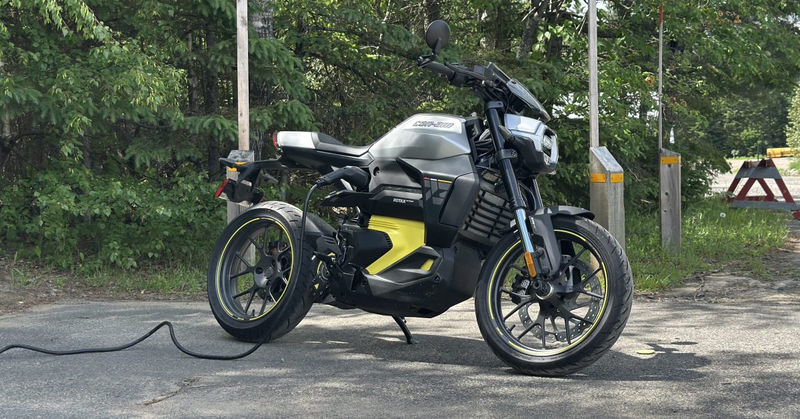
The Can-Am Pulse Does City Commuting Right—But Don’t Plan a Road Trip

The Can-Am Pulse is a genuinely fun, agile electric motorcycle that nails the daily commute for $10,999, but its lack of DC fast charging and some odd tech restrictions keep it from being a versatile travel companion. Over 570 km of mixed riding in sun, rain, and darkness, the Pulse proved itself as a nimble city slicer that’s easy to live with—if your life doesn’t involve highway stretches longer than a single charge.
At $10,999 (or $14,299 CAD), Can-Am undercuts both the Zero S ($13,495) and the LiveWire S2 Del Mar ($11,999) by a meaningful margin. For the 2026 model year, the price has dropped by as much as $3,000, making this the most accessible entry-level electric motorcycle from a major brand. But slashing the price also meant cutting corners—and the most obvious one is the absence of DC fast charging.

What You Get for the Money

The Pulse uses a 6.6 kW onboard charger that tops up from a Level 2 station in about 50 minutes. That’s competitive for the segment, but it means you’re tethered to a plug for roughly an hour after every hour of riding if you avoid highways. The bike’s top speed is capped at 129 km/h (80 mph), with power tapering off near that limit—fine for city on-ramps, but you’ll feel the pull fade as the needle climbs.
What you don’t get is a belt drive. Instead, Can-Am uses an oil-containing enclosed chaincase, which is more durable and doesn’t risk snapping like a belt under sudden torque. The battery and powertrain are also water-cooled, which helps longevity but adds cost and complexity. That water-cooling is overkill for a bike that can’t sustain highway speeds for long periods, but it does mean the battery will age gracefully.
Four ride modes (ECO, Normal, Rain, Sport+) let you dial in throttle response on the fly. Rain mode softens acceleration and maxes out traction control, which is reactive enough that I felt it stepping in on uneven pavement. The throttle itself is a highlight: you can adjust regenerative braking in three levels and even use a back-twist to add more regen. It’s a neat touch that gives you fine control—though I wish Can-Am let you map more of the twist range for that extra regen.

The Annoyances Add Up
The cooling fan runs constantly in 30°C weather. That’s a minor gripe, but it breaks the EV illusion of silent operation. Apple CarPlay is implemented with frustrating limitations: you can’t just glance at a map without also having audio or calls running—it demands a paired phone session even if you want only navigation. And the handlebar controls don’t play well with CarPlay’s touch-first interface, so adjusting anything while riding is impractical (and unsafe) with gloves.
The glove compartment lock is finicky, which feels cheap on a $10,999 vehicle. These aren’t dealbreakers, but they nibble at the polish.
How It Rides
This is where the Pulse shines. It’s quiet—almost silent save for a pleasant motor whine under full throttle—and the handling is light and immediate. I’m a taller rider, and I never felt cramped. The bike is nimble enough that you’ll be threading through traffic within minutes of your first ride.
Braking is confident, traction control is well-tuned (not overly intrusive), and the powertrain delivers smooth, predictable torque. You feel in control at all times, which is the highest compliment you can pay a commuter bike.

Value Proposition: A Precise Niche
At $10,999, the Pulse undercuts rivals by $1,000 to $2,500 in the US, and the gap is even wider in Canada thanks to tariffs. But the comparison isn’t apples-to-apples: the Pulse offers less power and range, and it’s physically smaller. It’s a commuter, not a tourer. Can-Am sells a bunch of accessories via its LinQ system (storage bags, passenger seat, top case), so you can outfit it for errands, but you can’t make it a road-trip machine.
The real question is whether the target audience knows the Pulse exists and is willing to spend $11,000 on a city-only electric motorcycle. The LiveWire S2 Del Mar is more expensive but offers DC fast charging and a belt drive. The Zero S has a bigger battery and more range. The Pulse’s value pitch rests entirely on its lower price and nimble character—which works, as long as you never need to ride it beyond city limits.
What Comes Next
Can-Am needs to address two things for the Pulse to reach a wider audience: add DC fast charging (even as an option) and fix the CarPlay implementation. Without those, the Pulse is a perfectly good city bike that actively discourages being taken on longer trips—and that limits its appeal in a market where many riders want one do-it-all machine.
For now, the Pulse is the affordable commuter EV that’s a joy to ride, but the asterisk is printed in large type: commuter only. If that describes your life, it’s the best deal in its class. If you ever dream of a weekend getaway on two wheels, keep shopping.
Comments (0)
Loading comments…